Showing posts with label Budget. Show all posts

Saturday, November 19, 2011

Dredging Up the Past and Much, Much More

The Monona city council meeting on Monday, November 21 promises to be a test of endurance. Not only do we have the second reading of the 2012 operating budget with 18 amendments but we also have a first reading of the2012 capital budget. And just because we all loooove talking about dredging at Belle Isle, we will be revisiting that topic; it's always a popular item and usually brings out the islanders in force (pro and con).

The major topic of debate on the operating budget is whether to cut the Monona police department staffing by one uniformed officer as Mayor Miller has proposed - or not as Alders Speight, Wiswell, and I have proposed. Chief Ostrenga provided some interesting data on crime stats and staffing (officers/1000 population). Kudos to Alder Busse for digging up the same (or very similar) data on his own. Wally put together a very useful summary memo that is in our paper packets, but not online (I think).

Profiles of some of the MOPD staff can be found here. The officer whose job is on the line is Officer Jared Wedig, a smart, motivated young guy in whom we have invested a lot of money and time. I can't see cutting an officer when we can afford to fund the position.

By the way, the budget still incorrectly states that the amendment I am co-sponsoring would be funded entirely from the fund balance. My original email said I wanted to use the small amount of room under the levy cap (around $50,000) first and then use the reserve fund. I restated that at the first reading, but it hasn't been changed. Reinstating the position would cost about $77K.

About the working capital reserve fund or fund balance. Back in 2003 when Robb Kahl took office, the reserve fund had shrunk to about 7%. The bond rating folks lacked gruntlement. They weren't happy peas in a pod. It looked like a listing fiscal ship. With Robb's leadership, the council adopted a policy of keeping the reserve fund between 15% to 20%. That policy was fundamental in the city's attaining a strong fiscal condition and thus, an extremely strong bond rating. I supported that policy and still do.

At the end of 2011, the city will have $977,069 or a reserve percentage of 20.71%.  If we keep the fund balance at 17.5% (smack dab in the mid-range of our policy), we will have $831,934. Thus, we have $145,135 available to apply to the city's operating budget. I would argue that is fiscally prudent and fair to taxpayers to return that $145,135 to the city's residents either in services or lower taxes.


See the box at the bottom of page 1 of the revised executive summary of the operating budget .


I plan to propose that we apply both money from the fund balance and money from the property tax cap room to each and every amendment. More specifically, I plan to propose that we pro-rate the use of levy cap room and fund balance so that we apply the same proportion of property taxes and fund balance to each amendment. The proposed amendments total $130K. Assume we have $50K in levy cap room. We would apply 38.46% (50/130) from the property tax levy and 61.54% (80/130) from the reserve fund. That way the amendments are all on the same fiscal ground and rise or fall or on their own merits.

Out for now...

Wednesday, September 21, 2011

Proposed City of Monona Operating Budget

Mayor Bob Miller's first operating budget for the city of  Monona is under review by the city council in Committee of the Whole meetings this week (Monday and Wednesday, September 19 and 21) (I missed the Monday meeting due to illness.). The capital budget for 2012-2013 will be reviewed soon after the operating budget review is reviewed.

The proposed 2012 operating budget is online. The most significant change is a reduction of one police officer. The budget also reflects increased employee contributions to retirement and, to a lesser degree, health insurance costs.

Saturday, August 27, 2011

Dredging Up History

The planned dredging project at Belle Isle is a major issue on the council's plate right now. I strongly believe the dredging will go forward either this fall or next year. It has been planned for a number of years, but a key difference that demonstrates the city's commitment to the project is that the city hired an engineering firm to prepare for the project. The lagoons have not been dredged since the early 1950's.

Under current ordinances, benefited property owners will pay 70% of the costs. Residents of that area also got hit with street special assessments this year, but the projects have both been in the works for years and it was known that both would likely take place in the same year or continuous years. (I note that when a road is first improved with concrete curb and gutter, abutting property owners pay 60% of the cost for the road work. The city taxpayers pay the other 40%. City ratepayers pay all of the costs for utility work.

Belle Isle residents are understandably upset that bids came in triple the amount of then-city engineer Rich Vela's estimate from a couple years ago. That cost jump is one reason we are considering re-bidding the project.

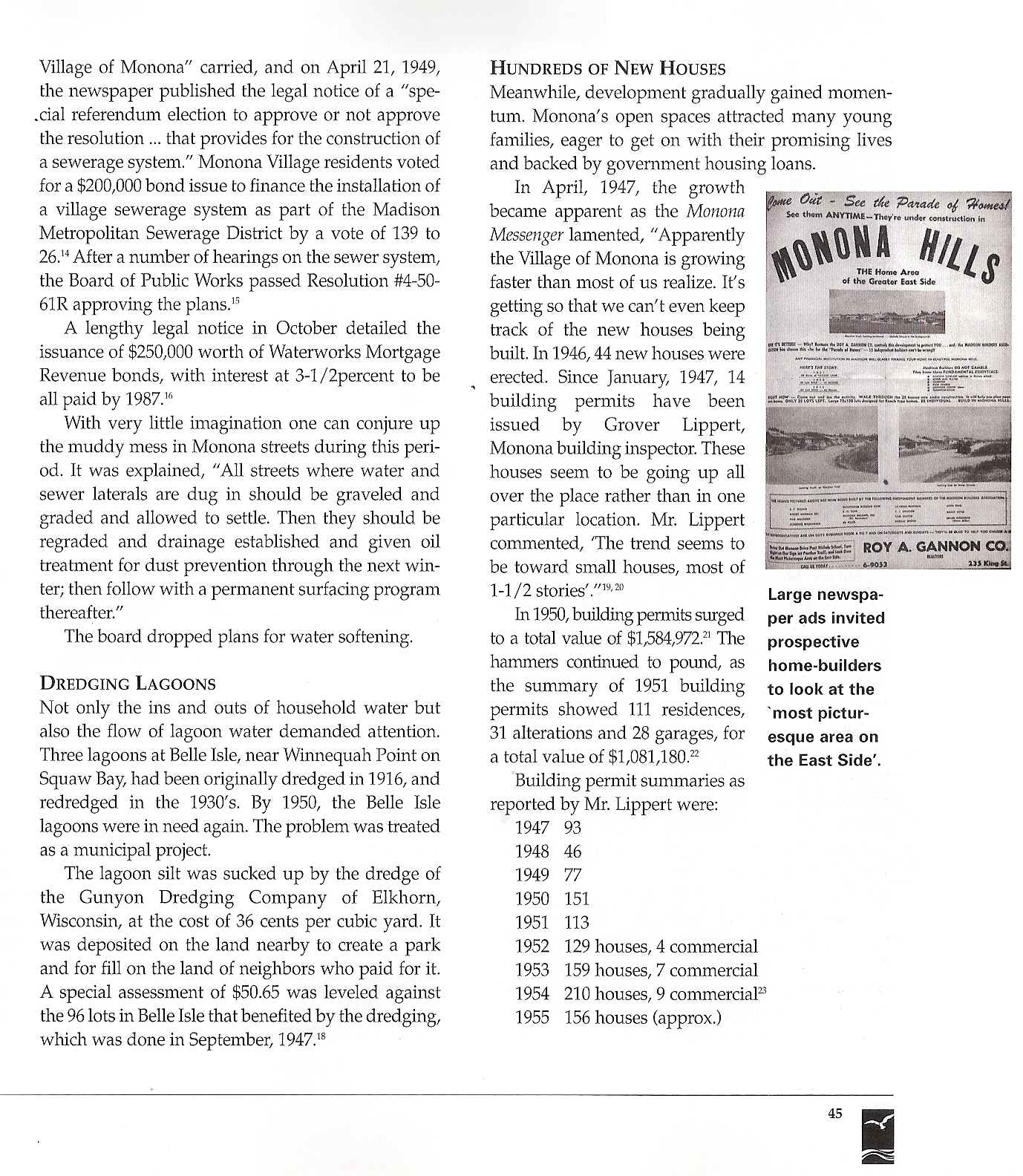
Here is a bit of history for the excellent Monona in the Making. Click to enlarge.


Sunday, August 07, 2011

Sunny Side Down

I get twitchy when our dear Sunny agrees with me. In this week's edition, she credits me for my comments that traffic signals are the obvious choice over a roundabout at Copps Avenue/Broadway. She then goes on to play whack-a-Chad because Chad didn't fold his tent and go home, but is pushing for the city to take another look at the roundabout option and get more data.

Background: The city is going to upgrade the Copps/Broadway intersection because of the increased traffic that will result from the two new clinics, the Menards expansion, and the eventual Whitehorse property development. The city administration said we would have the improvement done by the time the clinics opened and Meriter's clinic will be opening this fall.

Alder Speight (pronounced like "eight" NOT eighth") is asking us to look more closely at the total costs for each option. The total costs include societal economic costs, such as crash costs (property damage and injuries), wasted fuel, added pollution, and lost productivity from sitting at the traffic signals. On every measure, the total cost of traffic signals is higher, often much higher than the cost of a roundabout.

As I noted at the last council meeting (the scary one when I had the gavel), looking at total costs is not some wacky goofball idea. There is bloc of people who roll their eyes and close their minds whenever Chad says anything (OK, I know that he does tend to go on a bit, but that's because he's passionate about our city). We use net benefit analysis at my day job to help evaluate where to spend safety funds. Net benefit analysis is a very common practice in traffic engineering. The FHWA has a web page with links to various net benefit/cost models.  

The rub here is that these are external costs to the city, i.e. they do not come out of the city's budget.  They would not be imposed only on our residents, but on all users of that intersection. It makes complete sense to consider the external costs when using federal funds since those monies come from all of us (more or less) and thus should be spent in a way that benefits all of us.

Chad's persistence has caused me to take a second look. He and I requested that the city obtain these total costs from Vierbicher and they are working on it (at no added cost to the city). We shall see what the numbers say, but I fully expect the roundabout will be cheaper from the total cost standpoint. The analysis has to be tweaked to account for Copps/Broadway being a three-legged intersection in ways that will favor traffic signals (fewer T-bone crashes than you would expect at a 4-legged intersection), but I don't think that will change the total cost numbers.

The question then becomes whether we take money out of our own Monona pockets - and only our pockets - to cover these larger social/economic costs or not.

***

Here is one more website that does nice job laying out the factors to be considered.

Friday, July 01, 2011

DOA Letter to Local Officials on Collective Bargaining Changes

Dear Local Official:

As you know, 2011 Wisconsin Act 10 made significant changes to public employee
compensation and collective bargaining provisions in order to provide state and local
governments with the flexibility needed to reduce costs and maintain essential public
services.

In addition, 2011 Wisconsin Act 32, the state's biennial budget bill, included a
number of important modifications to Act 10. This letter explains these changes and
discusses several important implementation issues, including the effective dates of
changes to employee health and pension contribution rates, changes to collective
bargaining provisions and the discontinuation of payroll deductions for union dues.
While Act 10 is now in effect, the effective dates of various changes are dependent on
the status of your collective bargaining agreements. Changes in Acts 10 and 32 will
not apply to employees that are covered under current collective bargaining
agreements until those agreements expire, are terminated, extended, modified or
renewed. The provisions in existing contracts must continue to be honored.

For collective bargaining agreements that have expired or been terminated, the
discontinuation of union dues collection should be implemented no later than
the first pay period after June 29th.

For Wisconsin Retirement System (WRS), City of Milwaukee and County of
Milwaukee pension contribution rate changes, the effective date should parallel
as closely as possible the timing for state employees, who will first see these
deductions on their August 25th paycheck.

If your local governmental unit participates in a health insurance plan offered
by the Group Insurance Board (GIB), the health insurance contribution rate
changes are effective January 1, 2012.

Finally, local governmental units that do not have a civil service system as of
June 29th are required to establish a grievance system no later than the first
day of the fourth month beginning after the effective date of the bill. This
means that local governmental units must create these systems by October 1,
2011.

June 30, 2011
Page 2 of 3
Changes to Act 10

The following modifications, affecting local governmental units, were made to Act 10 in
the state's biennial budget bill and will be effective the day after publication of Act 32:

1) Transit workers, as defined by Wisconsin Employment Relations Commission
(WERC), are exempt from Act 10 provisions. In addition, WERC will be required to
provide training programs to prepare individuals for participation as arbitrators.
WERC is authorized to charge a fee for such training. Any labor organization
representing transit employees which violates the prohibition on strikes may not
collect dues for one year. At the end of the year, dues collection may be reinstated.

2) Emergency Medical Services providers were added to the definition of public safety
employees.

3) Arbitrators are required to give greatest weight to economic conditions relating to
settlement of disputes with public safety employees

4) The design and selection of health care coverage plans by the municipal employer
for public safety employees is no longer a subject of bargaining.

5) New public safety employees hired on or after the effective date of the bill are
subject to the requirement that they pay the same amounts toward their pensions
as general occupation employees as specified under Act 10.

6) In addition, new public safety employees hired by local governmental unit
employers who participate in health insurance plans offered by the Group
Insurance Board are required to pay at least 12 percent of the average premium
cost of the plan with the lowest premium cost, beginning on January 1, 2012.

7) School districts and technical colleges with collective bargaining agreements that
were initially entered into prior to February 1, 2011 are permitted to enter into a
memorandum of understanding (MOU) that reduces employer compensation or
fringe benefit costs. No MOU may be entered into later than 90 days after the
effective date of Act 32 and it must remain in effect for the duration of the existing
contract. As a result of this provision, every school and technical college district
should have the flexibility to realize pension and health savings comparable to what
the Governor projected they could.

8) Administrative Modifications

a) Employee contributions for retirement into the WRS must be made from the
employee's pre-tax income for the purposes of federal and state income taxes.
FICA tax calculations are unaffected. This reduces the employee's taxable
liability.

b) Employers are no longer required to recoup WRS or other local governmental
unit retirement payments from employees that were to begin on the first day of
the first pay period after March 13, 2011 under Act 10.

June 30, 2011
Page 3 of 3

c) Employees who serve under a fixed term appointment (e.g., Planning Board
Commissioner) are treated the same as elected officials in terms of the timing of
the change to WRS multipliers. The effective date of the 1.6% normal pension
benefit multiplier would occur on the first day of a term of office that begins after
the effective date of the bill. [Under Act 10, officials on fixed-term appointments
were not covered under the same delayed effective date as elected officials.]

d) The calculation of eligible wage increases under the Consumer Price Index (CPI)
has been modified such that the Department of Revenue would calculate the
average annual CPI for both state and local bargaining and that this calculation
only applies to base wages of represented staff to provide uniformity across the
state. The Department of Revenue will calculate the CPI upon a request from the
WERC. The CPI calculation will be based on the 12 months preceding the date
of the request from the WERC. If there is a decrease or no change in the CPI, the
base pay of employees in the collective bargaining agreement is frozen.

e) For those collective bargaining agreements that have expired or are operating
under an extension, the union certification vote as originally outlined under Act
10 must now occur in the third month after the effective date of Act 32. The
WERC is now required to assess and collect a certification fee for each election
that is conducted.

While implementation of Acts 10 and 32 will be challenging for all levels of the public
sector, I am confident that these changes will help set Wisconsin on a course toward
stable, affordable and effective government. State and local governments will become
more nimble in the face of change and be able to achieve continuous improvement.

Your thoughtful and measured approach to managing these changes along with
constant communication with employees will be critical to preserving government
services and Wisconsin's quality of life.

Sincerely,
Mike Huebsch
Secretary
cc: Governor Scott Walker
Keith Gilkes

Thursday, June 09, 2011

Monona City Council Report

The much awaited report of the June 7, 2011 Monona city council is finally here.

The Monona city council preview was here. Several items of interest are on the agenda.


*b. Consideration of Resolution 11-06-1782 Authorization to Proceed with Planning for Tax Increment District Amendment (CDA). This resolution would begin the process of amending TID #2. City Redevelopment Districts can be viewed here (related but not the same as TIDs). Somewhat dated TID map.TID #2 is at the southern end of the city along Broadway. Approved.

By the way, the State Senate have passed a bill to enact much stricter 'blight' standards for redevelopment. In this case they have taken the nub of a good idea and distorted beyond recognition. One analysis concludes the bill effectively turn out the lights on most redevelopment authorities (“RDAs”) and community development authorities (“CDAs”):


Since a blight finding is necessary for most RDA and CDA activities, the new restrictive blight standard would shut down substantially all activities of RDAs and CDAs, including, for example, lease revenue bond financings for tax increment projects, revolving loan and grant programs, the negotiated purchase of private property on a voluntary basis, providing assistance to private redevelopment of property, and making available conduit double tax-exempt financing to private development projects.

The Renew Monona Housing Loan program would be at risk under this bill.


* c. Consideration of Resolution 11-06-1783 Approval of Proposal from  
BT Squared for Design, Surveying, and Construction Engineering Services for 2011 Dredging Project (Public Works Committee). This item is a $54,000 engineering services contract. It concerns me that proposals were not sought from any other engineering firm. I copy the entire resolution below. BT Squared has done the engineering for the Belle Isle street project that is currently underway. Approved.

I ended up voting for the contract after one amendment). I still had strong reservations about the process, but was convinced that BT Squared will provide added value as a result of having been the engineer for the Belle Isle street project. They have developed a rapport and trust with the neighbors and they have developed more data beyond the street project that will be useful for the dredging project.

However, when Alder Wiswell not only supported the contract but also tried to sell the notion that the contract had received a full review through the proper procedures that was too much. City policy calls for getting multiple proposals on engineering services in excess of $15,000 and that was not done here.

Last, this alder just about suffered apoplexy on the council floor when Mayor Miller seemed to indicate a desire to reconsider part of the South Winnequah Road Safety Recommendations (City Administrator). It sounded to me like he was wavering on the necessity of the permanent speed display signs and that perhaps the Public Works Committee should take another look at it. Double apoplexy! The Council approved the plan so only the council can change the plan. We have beaten our heads against that wall too many times. Stop the madness!

Sunday, April 17, 2011

Monona City Council Preview - Monday, April 18 and Tuesday, April 19

Here's what's on tap for the last meeting of Mayor Robb Kahl's iron-fisted rule of the city of Monona (Joke Alert, look left):

Appearances.


1. Darren Marsh Regarding Dane County Open Space Plan and Yahara Recreational Trail. The new proposed plan: http://www.countyofdane.com/lwrd/parks/open_space_plan.aspx
The old worn out plan: http://www.countyofdane.com/lwrd/parks/planning.aspx#open_space_plans

E. Public Hearing.

1. To Receive Input Regarding the Proposed 2012-2016 Capital Improvements Program.

F. Consent Agenda.

1. Consideration of 2011 Temporary Class “B” Fermented Malt Beverage and “Class B” Wine Retailer’s License Application for Monona Festival, Inc., President James M. Bisbee, 6304 Roselawn Avenue, Monona, Wisconsin 53716, for the Period of July 2–4, 2011.

2. Consideration of 2011 Temporary Class “B” Fermented Malt Beverage Retailer’s License Application for Monona Grove Business Men’s Association, President Craig Hayes, 2140 Colladay Point Drive, Stoughton, Wisconsin 53589, for the Period of October 8, 2011.

G. Council Action Items.

1. Unfinished Business (Approval Requested Unless Otherwise Noted).

a. Consideration of Resolution 11-04-1771 Approval of 2012-2016 Capital Improvements Program (CIP) (Mayor Kahl). It is likely that the updated capital plan will be tabled or referred back to the appropriate committees. With a new mayor and new council member being sworn in on Tuesday, it seems like we should wait. The capital projects proposed for 2012 and 2013 projects are the critical years because the city usually borrows every two years. However, we will not borrow the funds until probably January 2012, so there isn't any urgency at this time.
b. Consideration of Resolution 11-03-1764 Compensating Non-Represented Employees for 2011 Wisconsin Retirement System Contributions (Tabled 4/4/11)(Mayor Kahl). Likely to be tabled pending resolution of the lawsuit challenging the "Collective Bargaining Kill Bill". It might be voted on in such a way that if the law is upheld against the pending court challenges, then this plan is ready to implement.

c. Consideration of Resolution 11-04-1769 Capital Transfer Request for 2011 Winnequah Firemen’s Park Shelter Restroom (Park and Recreation Director).

2. New Business.

a. Consideration of Resolution 11-04-1756 Approval to Purchase Flatbed Truck with Dump Body (Public Works Committee).

b. Consideration of Resolution 11-04-1773 Amending the Capital Budget for Additional Construction Engineering and Administration Services for 2011 Street and Utility Improvements Project (Public Works Committee).

***

On Tuesday, April 19, besides being Robb B. Kahl Day in the state of Wisconsin, the city council will hold its annual organizational meeting to complete the formalities of the election and swear in the new mayor, Bob Miller, and the three council members who were just elected. The council will elect a new Dear Leader (aka, Council President) and vote on the Mayor's committee assignment for the alders.

The meeting is scheduled to begin at 5:30 PM at City Hall (Large Conference Room).

The date is also Waco Day and Oklahoma City Bombing Day and Tom Running's birthday.

Monday, March 28, 2011

Parks & Open Space Plan Public Input Meeting - March 29

Parks and Open Space Plan Public Input Meeting

Date: Tue - 03/29/2011

Time: 6:00 PM

Location: Monona Community Center

The City of Monona and the Parks and Recreation Board invities the public to view the proposed 2012-2016 Parks & Open Space Plan for the City of Monona. There will be an opportunity to look at what improvements are being recommended at each park and have a question/answer session with Parks & Recreation Director Jake Anderson

This Meeting will be in the Senior Center level of the Monona Community Center.

Some background:
http://www.mymonona.com/pages/parks_recreation/parks_open_space/details.php/54/parks_services/park%2B%2Bopen%2Bspace%2Bplan/

A draft master plan for Winnequah, Ahuska, Lottes, and Oneida Parks:


Wednesday, March 16, 2011

Cronon on the Roots of the Wisconsin Conservative Political Movement

Highly recommended reading.


Bill Cronon has a new website (or rather web page on his website)

Who’s Really Behind Recent Republican Legislation in Wisconsin and Elsewhere? (Hint: It Didn’t Start Here)

A Study Guide for Those Wishing to Know More


After watching the sudden and impressively well-organized wave of legislation being introduced into state legislatures that all seem to be pursuing parallel goals only tangentially related to current fiscal challenges–ending collective bargaining rights for public employees, requiring photo IDs at the ballot box, rolling back environmental protections, privileging property rights over civil rights, and so on–I’ve found myself wondering where all of this legislation is coming from.,,
...I just don’t find it plausible that two brothers [David and Charles Koch] from Wichita, Kansas, no matter how wealthy, can be responsible for this explosion of radical conservative legislation. It also goes without saying that Scott Walker cannot be single-handedly responsible for what we’re seeing either...But he’s surely not the architect of that movement.


So…who is?...
Here’s my preliminary answer.

Telling Your State Legislators What to Do:

The American Legislative Exchange Council (ALEC)

The most important group, I’m pretty sure, is the American Legislative Exchange Council (ALEC), which was founded in 1973 by Henry Hyde, Lou Barnett, and (surprise, surprise) Paul Weyrich. Its goal for the past forty years has been to draft “model bills” that conservative legislators can introduce in the 50 states... Its website claims that in each legislative cycle, its members introduce 1000 pieces of legislation based on its work, and claims that roughly 18% of these bills are enacted into law...
If you’re as impressed by these numbers as I am, I’m hoping you’ll agree with me that it may be time to start paying more attention to ALEC and the bills its seeks to promote.

You can start by studying ALEC’s own website. Begin with its home page at


http://www.alec.org/

Tuesday, March 15, 2011

Thursday, March 10, 2011

State Budget Impact on Monona

The city staff has been working diligently to estimate the impacts of the state budget on Monona city government. These impacts will not occur until the city's 2012 budget - except that the change in pension contributions will take place in 2011.

Here are some of the numbers from the city administrator's weekly memo:

2011/2012 Budget Impacts – As discussed at the Council meeting earlier this week, the Governor’s Budget Adjustment Bill and and the proposed biennial budget will impact the City and our staff significantly. Cuts in aid to recycling ($47,000) and shared revenue ($77,482). The amount of lost transportation aid is uncertain. A 10% reduction would be about $60,817. The total reduction from these three items is $185,299.

The city government will have an expenditure decrease of about $70,000 from the transfer of 5.8% pension contributions to the nonrepresented employees. The change in pension contributions will take place in 2011. The employees covered by existing collective bargaining agreements would not make these contributions until those agreements expire in 2013 and 2014. The city administrator's recommendation is to reimburse the employees for this expense until December 31, 2011 since that money is budgeted through 2011. 

Click for the city's 2011 executive budget  

A sizable unknown is the impact of the state budget on the library aid that we receive from the county, which runs about $230,000 in the ciy's 2011 budget.

From the LRB budget bill analysis:

Under current law, to participate in a public library system a municipal, county,


or joint public library (local library) or a county must meet a maintenance of effort

requirement, which relates to the amount of financial support provided to the local

library or by the county for library services over the previous three years. This bill

repeals these maintenance of effort requirements.

Comment Time

After you toss your cookies, wipe your mouth off and toss your comments over here about tonight's zany doings down at the Dome. Here's mine.

Just when you think these folks can't come up with any more bad ideas, they do!

The Wisconsin Senate GOP suddenly realized tonight that the destruction of collective bargaining did not belong in the budget repair bill. "Gosh, how did that policy item get in there???" So, they did the only thing that a group of honorable and esteemed statesmen and stateswomen could do: They snatched it out of the budget despair and Presto! Change-O! It's a new bill, all by itself. It was such a wonderful idea, they just couldn't wait more to pass it.

So, they called a conference committee meeting late this afternoon or early evening on very short notice, yanked the collective bargaining stuff out. Sent that new bill to the Senate and the Senate approved it tonight and the Assembly will approve it tomorrow and then The Right Honorable, His Esteemed Smirkiness, Dear Leader Governor Walker signs it.

Gatherings around the water cooler are now banned, prohibited and verboten.

The headline on this story is incorrect (link below). The budget repair bill did not pass. They still don't have a quorum for that vote. The bill they passed was not the budget repair bill, it was a separate new anti-collective bargaining bill..

http://host.madison.com/wsj/news/local/govt-and-politics/article_8747fa04-4a74-11e0-8e6b-001cc4c03286.html

Did the Senate comply with the Open Meetings Law??? I don't know, but it sounds like maybe not.

Why the indecent haste? Maybe because the Democrats just might have come back to debate the separate bill and the GOP feared slippage. Schultz voted no. Two more votes and the collective bargaining bill would have failed. As a separate bill, it might have been easier for a couple more GOP senators to vote no.

Given some time, this maneuver just might have gotten the Dems to come back to fight the fight on this bill. Of course, that would have allowed the GOP to pass the budget repair bill.

On the other hand, why would they the Dems come back now?

Did the Senate comply with the Open Meetings Law??? I don't know, but it sounds like maybe not. And, yes, the law does apply to the legislature.


Think they complied with the spirit of the law:

OPEN MEETINGS OF GOVERNMENTAL BODIES


19.81 Declaration of policy. (1) In recognition of the fact

that a representative government of the American type is dependent

upon an informed electorate, it is declared to be the policy of

this state that the public is entitled to the fullest and most complete

information regarding the affairs of government as is compatible

with the conduct of governmental business.

***
 
19.84 Public notice. (1) Public notice of all meetings of a


governmental body shall be given in the following manner:

(a) As required by any other statutes; and

(b) By communication from the chief presiding officer of a

governmental body or such person’s designee to the public, to

those news media who have filed a written request for such notice,

and to the official newspaper designated under ss. 985.04, 985.05

and 985.06 or, if none exists, to a news medium likely to give

notice in the area.

(2) Every public notice of a meeting of a governmental body

shall set forth the time, date, place and subject matter of the meeting,

including that intended for consideration at any contemplated

closed session, in such form as is reasonably likely to apprise


members of the public and the news media thereof. The public

notice of a meeting of a governmental body may provide for a

period of public comment, during which the body may receive

information from members of the public.

(3) Public notice of every meeting of a governmental body


shall be given at least 24 hours prior to the commencement of such

meeting unless for good cause such notice is impossible or


impractical, in which case shorter notice may be given, but in no

case may the notice be provided less than 2 hours in advance of

the meeting.

(4) Separate public notice shall be given for each meeting of

a governmental body at a time and date reasonably proximate to

the time and date of the meeting.

 
19.87 Legislative meetings. This subchapter shall apply to


all meetings of the senate and assembly and the committees, subcommittees


and other subunits thereof, except that:

(1) Section 19.84 shall not apply to any meeting of the legislature

or a subunit thereof called solely for the purpose of scheduling

business before the legislative body; or adopting resolutions of

which the sole purpose is scheduling business before the senate or

the assembly.

(2) No provision of this subchapter which conflicts with a rule

of the senate or assembly or joint rule of the legislature shall apply

to a meeting conducted in compliance with such rule.

(3) No provision of this subchapter shall apply to any partisan

caucus of the senate or any partisan caucus of the assembly, except

as provided by legislative rule.

(4) Meetings of the senate or assembly committee on organization

under s. 71.78 (4) (c) or 77.61 (5) (b) 3. shall be closed

to the public.

History: 1975 c. 426; 1977 c. 418; 1987 a. 312 s. 17.